Electoral Circumstances: Raphael Warnock
Warnock's Battle for the Capitol

A Very Special Election Day
Warnock’s previous (and first election) was wild, unorthodox, and a huge victory, but the story of his triumphant win doesn’t exactly start with Warnock himself. Nor does it start in 2020, when he was formally elected. Instead, it begins in 2016 with a man named Johnny Isakson.

Johnny Isakson was the original congressman in (now) Senator Warnock’s position. Isakson was elected in 2016, despite being diagnosed with Parkinson’s disease in 2015. With mounting health challenges, Isakson announced his resignation from the Senate in August of 2019, and low and behold, a spot for Georgia’s newest junior Senator opened up in 2020 (fivethirtyeight.com).
Of course, before election time, there needed to be someone to fill Isakson’s spot while the show went on. Enter Kelly Loeffler—Warnock’s biggest challenger, first time politician, and (technically) Georgia’s newest incumbent. She was chosen by Governor Brian Kemp on December 4, 2019, and was sworn in on January 6, 2020 (gov.georgia.gov and ajc.com).
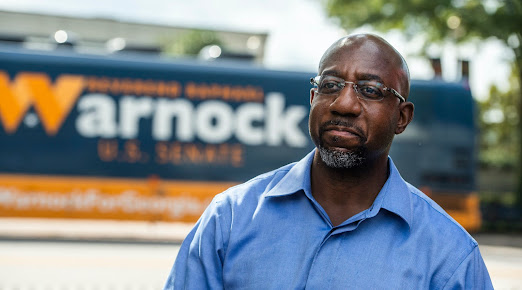
Warnock saw his opportunity and jumped at it, throwing his hat in the ring on January 30, 2020 with a video that launched his campaign. Filmed in the public housing he grew up in (totally homestyle), as well as the church he now serves at, he highlights financially struggling families as one of his main priorities (ajc.com). He earned multiple endorsements (some within hours of his announcement); from activist and politician Stacey Abrams all the way to former President Obama, there seemed to be a rally of well-known supporters for Warnock (politico.com and abcnews.go.com).
Unfortunately, Loeffler wasn’t the only candidate that Warnock had to worry about during this special election. In total, there were 20 candidates in the special election; eight Democrats, six Republicans, four Independents, one Green Party, and one Libertarian made up the ballot. These candidates included:
Raphael Warnock (D and our friendly face)
Matt Liebermen (D and son of former Senator Joe Lieberman)
Deborah Jackson (D)
Tamara Johnson-Shealey (D)
Jamesia James (D)
Joy Felicia Slade (D)
Richard Dien Winfield (D)
Ed Tarver (D)
Incumbent Kelly Loeffler (R)
Doug Collins (R)
Derrick Grayson (R)
Annette Davis Jackson (R)
Kandiss Taylor (R)
A. Wayne Johnson (R)
Allen Buckley (I)
Elbert Bartell (I)
Valencia Stovall (I)
Michael Todd Greene (I)
Brian Slowinski (L)
John Fortuin (G)
All information from (ballotpedia.org).
However, even with all these candidates (and no primary to sort the candidates out), Warnock and Loeffler ended up on top. Warnock led with 32.9% of Georgia’s votes, with Loeffler trailing behind with 25.9% (cnn.com), but with no majority vote for either of them, the election continued with a special runoff election on January 5, 2021.

The special runoff election was a close race, but as we know, our friend Reverend Warnock won with 51.0% of the vote, Loeffler only 2.0% behind him with 49.0% of Georgia’s vote (cnn.com). Warnock was sworn in on January 20, 2021.

Warnock’s victory was not only a historic one, as he was the first Black senator out of Georgia, but also incredibly important for Democrats. Warnock, and the senior Senate candidate, Jon Ossoff, were the two seats that tipped the Senate majority back into Democrat’s hands. Warnock's and Ossoff’s seats were needed to create a 50-50 split in the Senate, and along with Vice President Kamala Harris’s tie breaking vote, Democrats in the Senate were set. Indeed, much of the history that was made was overshadowed by the relief Democrats felt at the victory of the two newest Georgia senators (npr.org).

The Direction of Reelection
Once again, this story goes back to Johnny Isakson, who, as we know, resigned in the midst of his tenure. Unfortunately for Warnock, this also means that Warnock’s tenure ends when Isakson’s was supposed to. So, Warnock will already need to defend his seat come May 2022, with Georgia’s Democratic primary.
Warnock announced his intent for reelection for a full-term on January 27, 2021 (twitter.com), just one week after he was sworn in!
For the primary election, Warnock seems to be a shoo-in. He’s unchallenged at the moment, and with the primary election only two months away, it seems like he won't have any challengers at all (not to mention his incumbency advantage)! Overall, it looks like Warnock is going to win his primary, but his luck seems to falter when it comes to the general election outlook (realclearpolitics.com).

As for the general election (which will be November 8, 2022), Warnock has four challengers, all Republican; these include Herschel Walker (a former football player), Gary Black, Kelvin King, and Latham Saddler. Different websites give different outlooks for Warnock, but for the most part, Herschel Walker seems to be taking a bit of a lead. Real Clear Politics gives the election a toss-up rating, with Herschel only +1 over Warnock (realclearpolitics.com). However, other websites aren’t as hopeful, with CNN ranking Warnock in second place for “senate seats most likely to flip in 2022” (cnn.com).
My prediction: I think Warnock’s seat will unfortunately be flipped, even with the incumbency advantage. With Biden’s approval rating taking a nose dive in Georgia, I have a feeling that Georgia’s Democrats will be taking a major hit for it—including our friend Warnock.

Glance in the Finance

Major Issues
As for major issues, Warnock's reelection campaign has been focused on helping working-class families,
inflation, and health care; however, his website also highlights priorities such as agriculture, climate,
criminal justice reform, education, infrastructure, LGBTQ+, reproductive rights, national security and
defense, voting rights, veterans and military families, being bipartisan (or "working across the aisle"), and
immigration (warnockforgeorgia.com).
Working-class families and inflation is something that Warnock highlights the most—whether on social media or in advertising, it’s something that Warnock can relate to. Growing up financially struggling was something Warnock had experienced himself, and something Warnock specifically wants to help Georgia families with. His campaign team has promoted his introduction of legislation on lowering prescription costs and the $140 million in grants for affordable housing Warnock secured the most (cnbc.com).

Comments
Post a Comment